There are hundreds of hockey training equipment products out there, and most players buy in the wrong order - or buy gear that falls apart in a season.
This guide cuts through the noise. It ranks the equipment that actually moves the needle, tells you what to buy first, and shows you how to build a setup at home without wasting money.
Key Takeaways
-
Buy in priority order: shooting surface, stickhandling trainer, passing rebounder, pucks, then targets and agility gear.
-
A rebounder is the most underrated purchase because it lets you practice passing solo, no partner required.
-
Different pucks do different jobs - Green Biscuits for off-ice sliding, weighted pucks for strength, regulation pucks for the ice.
-
Pro-grade gear lasts for years and rebounds true; cheap aids warp, wobble, and get replaced every season.
-
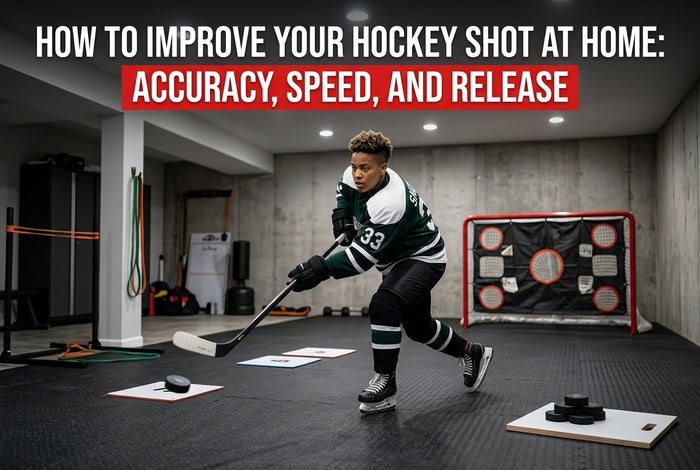
You can build a full training space in a garage, basement, or driveway with surprisingly little room.
The Priority Order: What to Buy First (and What Can Wait)
If you only buy one thing at a time, follow this sequence. It puts your money where the skill gains are biggest and prevents the overwhelm of trying to buy everything at once.
-
Shooting surface or board - lets you take thousands of reps off the ice without wrecking your blade.
-
Stickhandling trainer - builds soft hands through daily reps you cannot get at the rink.
-
Passing rebounder or aid - turns solo practice into real passing work.
-
Training pucks - the ammunition that makes every other tool useful.
-
Shooter tutor or targets - sharpens accuracy once your mechanics are solid.
-
Agility gear - hurdles and cones that build the footwork behind your skating.
Everything after that is an upgrade, not a necessity. Nail the first three or four, and you have a setup that develops the skills that decide games.
Shooting Gear: Boards, Pads, and Targets
Shooting is a reps game, and you cannot get enough of them on the ice alone. A shooting board gives you a slick surface that mimics the glide of ice and protects your stick blade from concrete. Pair it with a backstop or tarp so you are not chasing pucks, and add a shooter tutor when you are ready to work on picking corners.
-
Shooting board - a smooth, hard surface that replicates ice glide and saves your blade. Small travel models make it easy to train anywhere.
-
Backstop or shooting tarp - catches pucks and protects walls, so you can rip shots without cleanup between reps.
-
Shooter tutor - a net cover with numbered targets that turns shooting into a scoring game and trains accuracy.
Our Professional Grade Shooter Tutor uses 11 numbered targets - six high-scoring and five average-scoring - so every rep has a purpose. It is a fast way to turn mindless shooting into deliberate practice.
Stickhandling Trainers: Building Soft Hands Off Ice
Soft hands come from daily repetition, and most players simply cannot get that volume at the rink. That is where a stickhandling trainer earns its keep. Fifteen minutes a day in the basement builds the muscle memory that shows up in traffic on game night.
-
Ball-return and multi-sided trainers - give you resistance and a target to work around, building control and quick hands.
-
Weighted pucks and balls - overload your hands so a regular puck feels light and easy.
-
Obstacle setups - cones or trainers that force you to move the puck around and through pressure.
Our Fast Hands stickhandling aid is built for players from Mini-Mites to pros, with multiple sides that let you scale the challenge as your hands get quicker. No assembly required, and it holds up to daily use.
Passing Aids and Rebounders: The Most Underrated Category
Passing is the skill players neglect most in solo training, and the reason is simple: you think you need a partner. You do not. A quality rebounder returns the puck flat and true every time, so you can log hundreds of reps alone. This is the category that quietly separates good passers from great ones.
Not all rebounders are equal. Cheaper units use angled plastic that sends the puck back wobbling and unpredictable. A flat, solid rebound surface returns the puck on the tape, ready to shoot or move.
Our Give-N-Go passing aid was the first hockey puck rebounder to use solid rubber bumpers for a fast, flat, predictable rebound, and it is used by all 32 NHL teams. It works on and off the ice, so you can train in the garage or bring it to the rink.
Training Pucks: Why You Need More Than One Type
A puck is not just a puck. Each type trains something different, and having all three covers every situation.
| Puck Type | Best For | Why It Matters |
|---|---|---|
| Green Biscuit (off-ice sliding) | Passing and stickhandling on concrete or wood | Slides flat like a real puck without bouncing, so off-ice reps feel true to the ice. |
| Weighted puck | Wrist and forearm strength | Heavier than regulation, so it overloads your hands and makes a normal puck feel effortless. |
| Regulation puck | On-ice shooting and passing | The real thing - use it on ice and on a shooting board for game-accurate reps. |
A simple starter combo is a Green Biscuit for off-ice work plus a few regulation pucks. Add weighted pucks when you want to build shot power.
Agility and Conditioning Gear
Skills win puck battles, but footwork and conditioning get you to them first. A few simple tools build the speed and lateral movement behind good skating.
-
Agility hurdles - train quick feet, lateral power, and the crossover motion that drives your turns.
-
Cones - cheap and flexible for weave drills, stops and starts, and stickhandling courses.
-
Resistance bands - build hip strength that feeds your stride and crossovers.
-
Slide boards - simulate the glide and recovery of skating without ice.
Our Pro-Steel Agility Hurdles come in three heights so you can scale the work as you get faster, and they are built from heavy-duty steel that will not tip or crack like plastic sets.
Budget Tiers: Starter, Intermediate, and Full Setup
You do not have to buy everything at once. Here are three sensible tiers, from a lean starter kit to a complete training station.
| Tier | Approx. Investment | What's Included |
|---|---|---|
| Starter | Under $150 | A small travel shooting board, a Green Biscuit or training pucks, and a set of agility hurdles - enough to work shooting, hands, and footwork. |
| Intermediate | $300-$800 | Adds a passing rebounder and a shooter tutor for targeted passing and accuracy, or a bundled Dryland Intermediate Kit that packages the essentials together. |
| Full Setup | $1,500+ | A complete station with a passing aid, stickhandling trainer, shooter tutor, shooting surface, and agility gear - matching a Professional Grade combo or pro pack. |
Bundles usually save money over buying pieces one at a time. Our dryland training kits package the core gear at each level so you get a complete setup without guessing what fits together.
What Separates Pro-Grade Gear From Toy-Store Training Aids
The gap between real training equipment and toy-store aids shows up fast - usually the first time you use it hard. Here is what actually matters.
| Factor | Pro-Grade Gear | Toy-Store Aid |
|---|---|---|
| Construction | Heavy-duty steel, thick walls, solid rubber | Thin plastic that warps and cracks |
| Durability | Lasts for years, backed by a lifetime guarantee | Often replaced within a season |
| Rebound accuracy | Flat, fast, predictable return on the tape | Wobbly, angled returns that teach bad habits |
| Setup | No assembly required, ready to use | Fiddly assembly, loose parts |
Cheap gear feels like a deal until you replace it twice. Professional-grade equipment costs more up front and less over time, and it rebounds true so you are training the right habits instead of fighting the tool. Everything we build is made in Michigan and backed by a lifetime guarantee for exactly this reason.
Setting Up Your Training Space: Garage, Basement, or Driveway
You need less room than you think. Most players build a solid setup in a single-car garage or a corner of the basement. Use this checklist to get started.
-
Space: A flat area roughly 8 by 10 feet is enough for shooting and stickhandling; more is nice but not required.
-
Surface: A shooting board or smooth tiles protect your blade and mimic ice glide over concrete.
-
Backstop: Place a tarp or plywood behind your target to catch pucks and protect walls.
-
Rebounder placement: Set your passing aid a few feet away with clear space to receive returns.
-
Storage: Keep pucks in a bin and lean boards and hurdles against a wall so setup takes seconds.
Once the space is dialed in, the hardest part is done. The players who improve fastest are the ones who make training easy to start.
Frequently Asked Questions
1. Can I set up hockey training equipment in a small garage?
Yes. A single-car garage is plenty for a full off-ice setup. A flat area of about 8 by 10 feet fits a shooting board, a stickhandling trainer, and a rebounder. Add a tarp or backstop to catch pucks and protect the walls, and lean gear against a wall for easy storage between sessions.
2. What training equipment do NHL players use at home?
Many pros train with passing rebounders, stickhandling trainers, shooting boards, and shooter tutors for off-ice reps. Our Give-N-Go passing aid is used by all 32 NHL teams. The gear is not exotic - it is professional-grade versions of the same tools any dedicated player can set up in a garage or basement.
3. Are dryland kits worth it vs. buying pieces separately?
For most players, yes. A dryland kit bundles gear that works together and usually costs less than buying each piece on its own. It also removes the guesswork of matching tools. If you already own some equipment, buying individual pieces to fill gaps can make more sense than a full kit.
Ready to build your setup the right way? Explore all professional-grade training aids.