Agility separates good hockey players from excellent ones. Every stride, crossover, and quick stop on the ice depends on lateral power, hip mobility, and fast feet. Off the ice, agility hurdles are the cheapest tool that builds all three at once. The catch? Not every hurdle on the market is built for hockey. Plastic snap-tops crack the first time a Bantam stomps one, and adjustable knockoffs slide across the floor mid-drill. This guide walks through what to look for, how to drill correctly, and which heights match each age group, all without overselling a product that won't survive a Michigan winter.
The best agility hurdles for hockey players are adjustable steel hurdles, six to 18 inches tall, sturdy enough to stay in place during lateral shuffles and crossover drills. Steel survives cold garages, won't crack under youth feet, and lasts decades. Plan on at least four hurdles for solo work and six to eight for team drills.
Key Takeaways
-
Steel hurdles outperform plastic on durability, stability, and cold-weather use.
-
Six-inch hurdles for Mites and Squirts, nine to 12 inches for Peewee and Bantam, 12 to 18 inches for high school and adults.
-
Lateral and crossover drills transfer to skating speed faster than straight sprint work.
-
Hurdles pair best with stickhandling and passing aids in a complete dryland station.
-
Two short agility sessions a week are enough to see edge-work gains inside a month.
Why Do Agility Hurdles Matter for Hockey Performance?
Hockey is not a straight-line sport. The fastest skater on your team is rarely the fastest sprinter. Watch any NHL replay, and you'll see edge work, crossovers, and lateral cuts that look more like a tennis player than a track athlete. Agility hurdles build exactly those movement patterns off the ice, which means more reps per week than ice time alone can offer.
-
Lateral quickness: Repeated side-to-side hops train the same hip drive used on crossovers.
-
Hip flexor strength: Knee-up patterns over hurdles unlock the hip without heavy weights.
-
First-step explosion: Single-leg hops build the same fast-twitch fibers that launch you out of a board battle.
-
Edge transfer: Foot-down balance over hurdles teaches the same outside-edge load used in tight turns.
-
Youth safety: Controlled hurdle work is lower impact than max-speed sprints, which is better for growing joints.
This is not generic gym agility. Hockey demands lateral movement patterns that hurdles specifically train, especially when you combine them with stickhandling on a Fast Hands trainer, so the brain learns to multitask under fatigue.
What Should You Look for When Buying Agility Hurdles for Hockey?
Material and Construction
There are three common materials, and the difference is huge once a 130-pound Bantam clips one at full speed.
-
Plastic snap-top: Cheap, light, breaks fast. Cracks in cold weather. Avoid for serious training.
-
PVC pipe: A step up from snap-top, but still bends and warps after a year of use.
-
All-steel, powder-coated: Stays straight, survives stomps, doesn't crack in a 30-degree garage.
The Pro-Steel Agility Hurdles are built from 11-gauge steel with a powder-coat finish, made in the USA, and backed by a lifetime guarantee. If a kid steps on one, it doesn't snap. If a coach forgets one outside, the next morning it's still flat.
Height and Adjustability
Hockey players need more than one height. A 6-inch hurdle is perfect for tempo work, but useless for power. An 18-inch hurdle builds explosive hops, but it tweaks young hips if you start there too soon.
-
6 inch: Tempo drills, speed-of-foot, Mini-Mites to Squirts.
-
9 to 12 inch: Lateral shuffles, knee-ups, Peewee to Bantam.
-
18 inch: Power and explosive hops, high school and adult players.
-
Adjustable sets: One purchase that grows with the athlete and the season's focus.
Weight and Stability
A hurdle has to be light enough to carry and heavy enough not to slide when you graze it. Cheap plastic ones bounce out of the way the second your foot brushes them. Steel hurdles stay planted. The result is faster, more confident drills, because a clip becomes feedback instead of a tripping risk.
How Many Hurdles Do You Need?
-
Solo training: Four hurdles, minimum. Enough for shuffles, hops, and a short ladder.
-
Two players at home: Six to eight. Lets you run reaction drills and short sequences.
- Team training: 10 to 16 across two or three stations. Coaches running circuit drills want flexibility.
Six Hockey-Specific Agility Hurdle Drills
These six drills cover lateral, linear, and reactive demands. Run them as a circuit, 30 seconds work and 30 seconds rest, for 12 to 20 minutes. Add the Fast Hands stickhandling aid on the final drill to teach the brain to handle the puck under fatigue.
- Lateral Shuffle Over Hurdles. Set six hurdles in a line. Shuffle sideways over each, both feet inside, before moving to the next. Builds the same hip drive used in crossovers. 3 sets of 30 seconds.
- Single-Leg Hop Series. Hop over four hurdles on one leg, walk back, switch sides. Builds explosive ankle and knee power. 3 sets of 6 reps per leg.
- Forward-Backward Hurdle Sprint. Sprint forward over five hurdles, backpedal. Trains the transition every backchecking forward needs. 4 sets of 5 reps.
- Crossover Step Drill. Place six hurdles in a slight arc. Crossover step pattern through them, leading with the inside foot. Mimics on-ice crossovers exactly. 3 sets of 30 seconds each direction.
- Hurdle + Stickhandling Combo. Lateral shuffle over hurdles while stickhandling a puck with the Fast Hands trainer. Hardest drill on the list. 3 sets of 45 seconds.
- Reaction Drill. Partner calls 'left,' 'right,' 'forward,' or 'back.' Player explodes over the matching hurdle. Builds reaction speed. 4 sets of 30 seconds.
Hurdle Recommendations by Player Type
| Player Type | Recommended Height | Quantity | Key Drills |
|---|---|---|---|
| Mites and Squirts (8U-10U) | 6 inch | 4 to 6 | Lateral shuffle, fun coordination patterns |
| Peewee and Bantam (12U-14U) | 9 to 12 inch adjustable | 6 to 8 | Crossover step, single-leg hops, sprint-backpedal |
| High school and adult | 12 to 18 inch | 8 to 10 | Power hops, reaction drill, hurdle plus stickhandling combo |
| Coaches and teams | Adjustable, multiple heights | 10+ | Station-based circuits, reaction drills |
How Do You Build a Complete Off-Ice Agility Station?
Hurdles work best as part of a station, not a one-off. Pair them with an agility ladder, cones, and a stickhandling tool, and you have a full 20-minute circuit that builds skating speed, hand coordination, and game-ready endurance.
-
Hurdle zone: 4 to 8 hurdles in a 6 by 10 foot lane.
-
Ladder zone: A 15-foot agility ladder for tempo work.
-
Cone work: Six markers for cuts and zig-zag sprints.
-
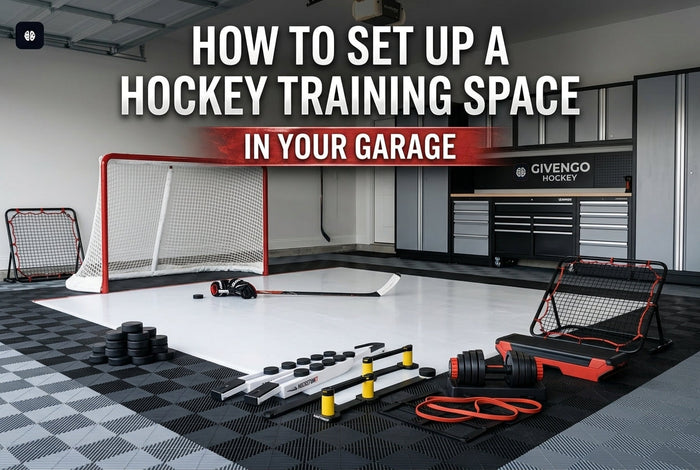
Stickhandling station: A 4 by 6 foot pocket with the trainer and a few pucks.
-
Passing target: A 30-inch passing aid off to the side for reaction passes.
Last season, I had a client run this exact circuit three days a week in his garage. Six weeks in, his coach asked if he had grown. He hadn't. His acceleration just looked different. That kind of jump is normal when off-ice work matches the demands of the game. Browse dryland training kits for pre-built bundles that include hurdles and complementary trainers.
How Do Agility Hurdles Translate to On-Ice Speed?
Coaches ask this question every season. The short answer is that lateral hurdle work fires the same hip and glute pathways that load a crossover. Off-ice reps drill the pattern slow enough that the brain locks in the motor program. When the player hits the ice, the legs already know the move. The only new variable is the edge. That is why two short sessions a week often produce faster crossovers by the end of a month, even when total ice time stays flat.
Plyometric science backs this up. Hops, bounds, and lateral cuts build elastic strength in the tendons, which is the springy quality that lets a skater explode out of a turn. You cannot get that with weight room squats alone. You need movement that mimics the sport. Hurdles fit the bill, cost less than a single private lesson, and last decades. That math is hard to beat.
Add a stickhandling trainer to the same circuit, and you stack two skills at once. Players who train hands and feet together adapt faster than players who split the two.
Frequently Asked Questions
What height agility hurdles are best for youth hockey?
Stick to six-inch hurdles for Mini-Mites and Squirts. Move to nine or 12 inches as players hit Peewee and Bantam levels. High school athletes graduate to 12 to 18 inch hurdles. Adjustable sets are the smartest pick because they cover every age.
Are plastic or steel hurdles better for hockey training?
Steel wins every time. Plastic cracks when stepped on, especially in cold garages. Steel stays planted, lasts decades, and gives the athlete real feedback when they clip the bar. The Give-N-Go Pro-Steel hurdles are powder-coated and carry a lifetime guarantee.
How many agility hurdles do I need?
Four hurdles are the minimum for solo work. Six to eight is ideal for a home setup with two players. Teams running circuits want 10 or more, so multiple stations can run at once.
Can you use agility hurdles on ice?
Yes, for low hurdles in tempo drills, but most coaches keep hurdles off-ice. The cold makes plastic hurdles brittle, and the friction on tile or rubber gives a better feel for footwork. Use the ice for skating drills, the garage for hurdle work.
How often should hockey players do agility training?
Two short sessions a week are enough during the season. Bump to three or four sessions in the off-season when ice time drops. Quality and intent matter more than total volume.
Faster Feet, Cheaper Than Ice Time
Agility hurdles are one of the highest-leverage tools in dryland training. Pick a steel adjustable set, run the drills two or three times a week, and you will see lateral speed gains in a month. Shop Pro-Steel Agility Hurdles in 6, 12, and 18 inch heights, or browse the full fitness equipment collection for bundle savings. Questions on what fits your space? Call 248-831-1692, and we'll match you to the right setup. Lifetime guarantee, Made in Michigan, no assembly required.