Structured off-ice training improves skating speed by roughly 8%, shot power by about 10%, and cuts injury risk by around 15%. Off-ice hockey training, also called dryland training, is any structured physical or skill work done away from the rink to make you better on it.
This single guide covers everything a player needs, from stickhandling in the driveway to building real strength in the gym, for every level from Mini-Mites to pros.
Ice time is limited and pricey. Off the ice, you can get ten times the repetitions for free, on your own schedule. That is why the training ideas here are the same ones used by all 32 NHL teams, thousands of college programs, and youth clubs around the world. Whether you are a parent setting up a first home routine or a junior player chasing the next level, this is your roadmap.
Key Takeaways
Off-ice training builds strength, speed, puck skills, injury resistance, and faster development.
Pros train roughly two hours off the ice for every hour on it, because reps win.
The six pillars are strength, speed and agility, stickhandling, shooting, passing, and recovery.
Scale everything to age and stage. Bodyweight for kids, loaded strength for teens, power work for adults.
A modest home setup plus a simple program beats expensive ice time you cannot always get.
What Off-Ice Hockey Training Is and Why It Matters
Off-ice hockey training is any structured physical or skill training done outside an ice rink to improve on-ice performance. That includes strength work, conditioning, stickhandling, shooting, and passing drills you can run at home.
Five benefits make it essential. It builds the strength skating demands. It develops the speed and explosiveness that beat defenders. It sharpens puck skills through high-rep practice. It prevents the hip, groin, and knee injuries common in hockey. And it accelerates overall development by adding reps you would never fit into team practice.
Here is the math that convinces most parents. Ice time is expensive and rationed, so a player might touch the puck for a few minutes across a whole practice. At home with a stick-handling aid, that same player gets thousands of touches a week. Pros live by a rough two-to-one ratio, two hours off the ice for every hour on it, and they do it because the reps add up.
Pillar One: Strength Training for Hockey
Hockey demands lower-body power for skating, core stability for balance and shooting, and upper-body strength for battles and shot force. Build all three, scaled to age.
Beginner: Bodyweight Foundation (Ages 8 to 13)
Push-ups, squats, lunges, planks, and wall sits cover it. Two or three sets, moderate reps, with rest between. The priority is clean form, not load. A young athlete who owns a proper squat and plank is set up for everything that follows. Keep it light, keep it consistent, keep it fun.
Intermediate: Loaded Strength (Ages 14 to 17)
Now add external load: goblet squats, light deadlifts, bench press, rows, and weighted lunges. Train three or four days a week and chase gradual progressive overload, small jumps over time rather than big ones. Technique under a coach's eye matters more than the number on the bar at this age.
Advanced: Power Development (Ages 18+)
This level runs barbell squats, trap-bar deadlifts, power cleans, single-leg work, and rotational med-ball throws, all inside a periodized plan that shifts focus across the year. The goal is explosive power that shows up in the first three strides and in board battles.
Pillar Two: Speed, Agility, and Conditioning
Hockey is a game of short, violent bursts: lateral pushes, hard stops, quick changes of direction. Train those patterns directly.
Agility Drills
Ladder work, cone drills like the 5-10-5 pro agility and the T-drill, and lateral bounds teach your body to change direction fast. Agility hurdles add a jump-training element that builds quick, springy feet. Keep the efforts short and the quality high.
Sprint and Conditioning Work
Hockey is a sprint sport, not a marathon. Train it that way. Short sprints of 10 to 40 yards, hill sprints, and intervals of 30 seconds hard followed by 30 seconds easy build the right energy system. Long, slow jogging does little for a shift that lasts under a minute.
Plyometrics for Explosive Power
Box jumps, broad jumps, single-leg hops, and depth jumps train the fast-twitch fibers behind explosive starts and hard checks. Land softly, rest fully between reps, and treat quality as the whole point. Plyometrics are about output, not exhaustion.
Pillar Three: Stickhandling Off the Ice
Soft hands are made at home, in front of the TV, in the garage, anywhere with a flat surface and a few minutes.
Essential Stickhandling Drills
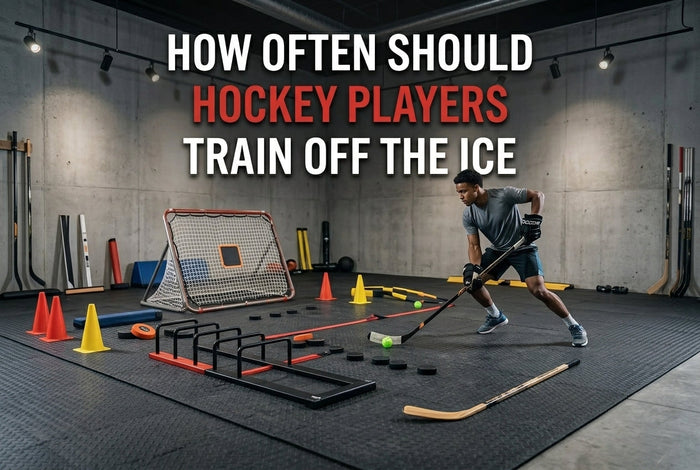
Start basic: side-to-side, fore-and-aft, and figure-8. Build to handling around obstacles and in tight space. Then push into advanced work like eyes-up or no-look reps and two-puck handling. A stickhandling ball or a Green Biscuit on a smooth surface works, and the Fast Hands Pro Model gives a five-sided training surface that pushes hands to react in every direction.
Build a Stickhandling Course at Home
Set up a course with household items or training aids: cups, cones, a few markers spread across the floor. Run it for time, then try to beat that time next week. Add difficulty by narrowing the gaps or speeding up the tempo. Timed runs turn vague practice into a game you can win against yourself.
Pillar Four: Shooting Off the Ice
Shooting deserves its own deep dive, but here are the essentials. Practice the wrist shot, the snap shot, and the backhand, because games demand all three.
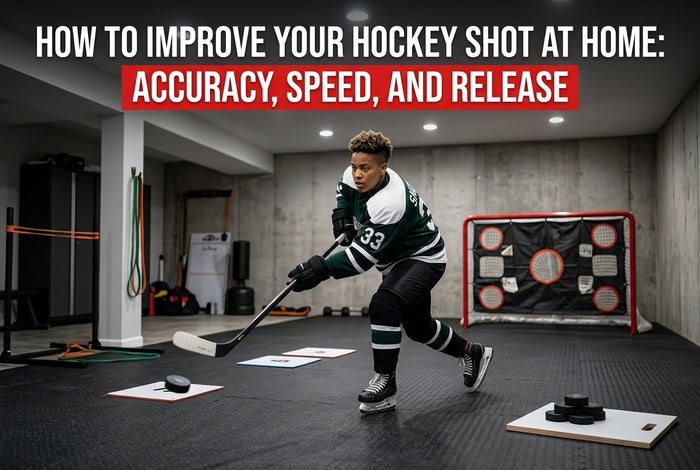
A proper surface matters. A shooting board gives a realistic puck slide and protects your blade, while a shooter tutor with eleven numbered targets lets you aim at real spots and track accuracy over time. Pick a target, fire ten, log your hits, then switch. Power comes from weight transfer and stick flex, not your arms, so build the motion slowly before you add speed. For a full breakdown of accuracy, power, and release, pair this section with focused shooting practice.
Pillar Five: Passing Skills Off the Ice
This is the most overlooked area in off-ice training, and almost no guide covers it well. Great passers control the game, but passing usually needs a partner.
Why Passing Deserves Real Practice
Most home training is solo work, so passing gets skipped. That is a missed opportunity, because crisp, accurate passing is what turns five individuals into a line. The barrier has always been needing someone to pass with. A quality rebounder solves it.
Off-Ice Passing Drills
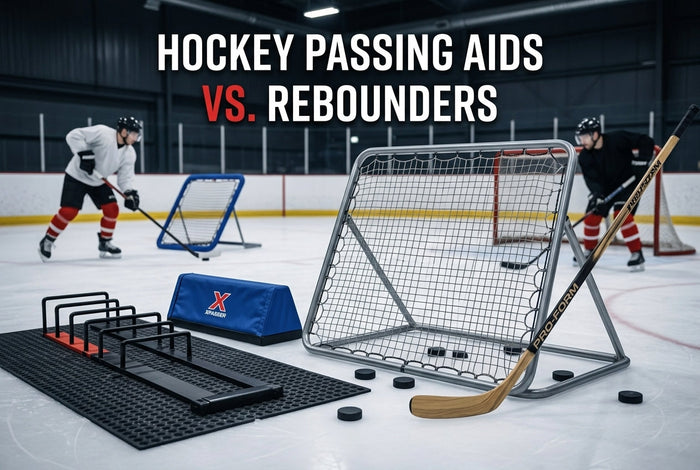
A passing aid gives a fast, flat, predictable rebound that mimics receiving a real pass. Run saucer passes off a ramp, one-touch passing into the rebounder, rapid-fire passing sequences, and forehand-to-backhand alternation. The solid rubber bumpers return the puck the same way every time, so you can build timing and soft reception without a partner. Fifteen focused minutes a few times a week makes a visible difference.
Pillar Six: Recovery and Injury Prevention
Everyone names this pillar, and almost nobody develops it. Recovery is where adaptation actually happens.
Stretching and Mobility
Skating leaves hips and groins tight, which is exactly where hockey players get hurt. Daily mobility work, hip flexor stretches, groin stretches, shoulder mobility, and foam rolling keep those areas healthy. Ten minutes a day prevents the injuries that cost weeks.
Rest, Nutrition, and Sleep
Rest days are part of training, not a break from it. Aim for seven to nine hours of sleep, since that is when the body rebuilds. Keep nutrition simple: protein to repair muscle, carbs for energy, and steady hydration. None of this is complicated, but consistency is what makes it work.
Building Your Home Training Setup
You can start small and grow. Here is a budget-tiered path.
-
Starter, about $100 to $200: a stick, balls or Green Biscuits, and cones. Enough for stickhandling and footwork.
-
Mid-level, about $200 to $500: add a stickhandling trainer, a shooting board, and agility hurdles.
-
Complete home gym, about $500 to $1,500: add a passing aid, a shooter tutor, and a full kit.
If you want one decision instead of ten, the Dryland Intermediate Kit bundles the essentials together. Everything is made in the USA, professional grade, backed by a lifetime guarantee, and ships with no assembly required. Browse dryland kits or the full set of training aids to match your budget.
A 4-Week Off-Ice Training Program
Here is a plan you can start this week. Bookmark it and run it twice through for a full cycle. Weeks 1 and 2 build the foundation with three sessions a week. Each session opens with a warm-up, moves through one or two pillars, then closes with mobility. A typical week: strength on Monday, skills on Wednesday, speed and agility on Friday.
Weeks 3 and 4 step up to four sessions. Add a second skill day and increase intensity slightly. Keep rotating through the pillars so nothing gets neglected, and hold one full rest day no matter what. Use the free training drills to fill in each session and keep it fresh.
One more note on the program: write down what you do. A quick log of sessions, weights, and times keeps you honest and shows progress you would otherwise forget. After four weeks, take a day to test a few markers, a timed stickhandling run, your shot accuracy, a sprint, and compare them to where you started. That feedback is what keeps a routine alive past the first burst of motivation.
Frequently Asked Questions
Does off-ice training really work?
Yes. Structured dryland work produces measurable gains in skating speed and shot power and lowers injury risk. The key is consistency with equipment and drills that mimic real game movements.
What age should players start?
A reasonable starting point for structured work is around second or third grade, roughly age 8 to 9. Before then, free play and a mix of sports build the athletic base. Specializing too early usually does more harm than good.
What equipment do I need?
At minimum, a stick and balls or biscuits. To train every skill, add a stickhandling aid, a shooting surface, a shooter tutor, a passing aid, and agility hurdles.
How often should I train off the ice?
Two to five sessions a week depending on age and season. Off-season runs higher; in-season drops to maintenance. Quality beats quantity every time.
Can I train every day?
Light skill work, yes. Hard strength and conditioning, no. Build in rest days so your body can adapt and get stronger.
What are the best exercises for skating speed?
Lower-body power moves like squats, single-leg work, plyometrics, and lateral bounds, plus sprint intervals. These build the explosiveness skating rewards.
What are the best exercises for shot power?
Rotational core work, leg drive exercises, and movements that load the shooting motion, such as med-ball throws and band rotations, combined with proper shooting mechanics.
How do I train without equipment?
Bodyweight strength, sprints, plyometrics, and mobility need nothing but space. Add a stick and a ball, and you can also work hands. Equipment speeds progress but is not required to start.
Can goalies benefit from dryland training?
Absolutely. Goalies gain from mobility, lateral power, reaction work, and stickhandling. Better hands and quicker pushes make a real difference in net.
Is off-ice training safe for youth?
Yes, when it is age-appropriate. Young players focus on bodyweight movement and fun, with proper supervision and form. Load and intensity rise gradually with age.
Start Your Off-Ice Training Journey
Every great player on the ice was built off the ice. The six pillars- strength, speed, stickhandling, shooting, passing, and recovery - give you a complete plan, and the only thing left is to start. Pick your level, set up your space, and run the program.
Need help choosing gear? Call 248-831-1692 or contact our team. Grab your free Green Biscuit with every hockey equipment order, explore our dryland kits, and build the player you want to be, one rep at a time.